Πέμπτη 21 Απριλίου 2011

fairyhouse-nail fungus


Poronia punctata has not been officially assessed for the IUCN Red List of Threatened SpeciesTM, but a provisional assessment of its status is thought to be ‘Vulnerable’. It is a microscopic fungus, found exclusively on old dung, usually of donkeys and horses, and occasionally of cattle and elephants. It produces a greyish disc about 15 mm in diameter on the surface of the dung. Many individual fruit-bodies are embedded in the disc, each with an exit channel for its spores. The tops of these channels appear as tiny black points on the disc surface.
Where vehicles have replaced donkeys and horses, populations have declined, making this fungus extremely rare in some parts of the world, particularly Europe. To compete with fungi already present on old dung, Poronia punctata produces antibiotics. Unfortunately, it too is sensitive to non-natural products, such as additives in the food of animals producing the dung, which is an additional factor in its decline.
The fungus is now strongly associated with herbivores on unimproved grasslands, particularly hay meadows, and its conservation therefore requires additive-free food for those herbivores, and protection of the unimproved grasslands where they live.


******


Τρίτη 19 Απριλίου 2011

fairyhouse-ceasar's mushroom


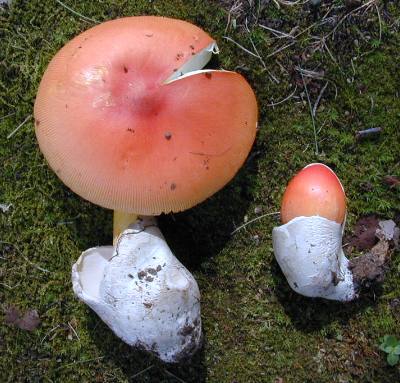
Amanita caesarea, commonly known in English as Caesar's Mushroom, is a highly regarded edible mushroom in the genus Amanita, native to southern Europe and North Africa. It has a distinctive orange cap, yellow gills and stem. Similar orange-capped species occur in North America and India. It was known to and valued by the Ancient Romans, who called it Boletus, a name now applied to a very different type of fungus.


This mushroom has an orange-red cap, initially hemispherical before convex and finally flat. The surface is smooth, and margins striated, and it can reach 15 (6 in) or rarely 20 cm (8 in) in diameter. The free gills are pale to golden yellow, as is the cylinder-shaped stipe, which is 8–15 cm (3–6 in) tall and 2–3 cm ( around 1 in) wide. The ring hangs loosely and is lined above and smooth below. The base of the stipe is thicker than the top and is seated in a greyish-white cup-like volva, which is a remnant of universal veil. The spores are white.
It could be confused with the poisonous fly agaric (Amanita muscaria). Though A. muscaria has a distinctive red cap dotted with fluffy white flakes, these tend to fall off as the carpophor ages and the bright red tends to fade to a yellowy orange. The latter mushroom will always have white gills and stalk with a ringed volva rather than a yellow stalk and is typically associated with spruce (Picea), pine (Pinus) or birch (Betula).Certain varieties ( eg. Amanita muscaria var. guessowii ) are close to yellow even at the juvenile stage.


The common name comes from its being a favorite of the Roman emperors, who took the name Caesar as a title.  However, the most famous killing involving Amanita took place in ancient Rome circa 50-60 A.D. The Emperor Claudius had ascended to the throne after the assassination of his nephew Caligula. We've all heard about the decadence (and Roman porno movies, such as "Veni, Vidi, Veni") associated with Caligula. Anyway, Claudius had several wives, but finally married his fourth wife Agrippina, who was also his niece. Agrippina already had a son from a previous marriage, Nero, for whom she had great plans. She persuaded Claudius to adopt Nero, putting him in line for the throne, should something happen to Claudius. (You can see where this is going already.) Agrippina was an impatient woman, and could not wait for a natural death for Claudius; she plotted to kill him by feeding Claudius his favorite meal, Amanita caesarea, laced with extracts from Amanita phalloides, the death cap. When the symptoms set in the next day, a co-conspirator doctor Xenophon administered an enema of colocynth, a potent toxin from a plant called bitter apple, which together with the mushroom toxin killed Claudius. Nero and his fiddle thus became emperor, and the rest, as they say, is history. 


****** 


fairyhouse-Collared Parachute


Marasmius rotula is a species of fungus in the Marasmiaceae family of mushrooms. It is also commonly known variously as the pinwheel mushroom, the pinwheel Marasmius, the little wheel, or the horse hair fungus.
This eastern species is often overlooked because it is so tiny; the caps max out at two centimeters in diameter, and are usually half that size or smaller. It is found in hardwood forests from spring to fall, growing from sticks and other woody debris. Marasmius capillaris is very similar, but grows from leaf litter.


The attachment of the gills is by means of a tiny "collar" that circles the stem. Additional distinctive features include the dark, wiry stem; the pleated white cap that has a flat top when viewed from the side (the cap of Marasmius capillaris, in contrast, is evenly rounded); and the absence of a distinctive taste or odor.
Other "pinwheel" species include the orange Marasmius siccus, the pink Marasmius pulcherripes, and the rusty Marasmius fulvoferrugineus.


Marasmius rotula is considered inedible but not poisonous.

Ecology: Saprobic on sticks and woody debris in hardwood forests; growing alone or gregariously (or in clusters); spring through fall; widely distributed east of the Rocky Mountains.
Cap: .5-2 cm; convex, but soon with a central depression; pleated; appearing to have a flat top and squarish sides when viewed from the side; smooth; dry; brownish in the depression, whitish elsewhere.
Gills: Attached to a tiny "collar" that encircles the stem; white to yellowish white; distant.
Stem: 1.5-8 cm long; 1-2 mm thick; equal; dry; shiny; wiry; pale at first but soon dark brown to black except at the apex; base sometimes with stiff hairs.
Flesh: Thin.


*********


Δευτέρα 18 Απριλίου 2011

fairyhouse-branching oyster


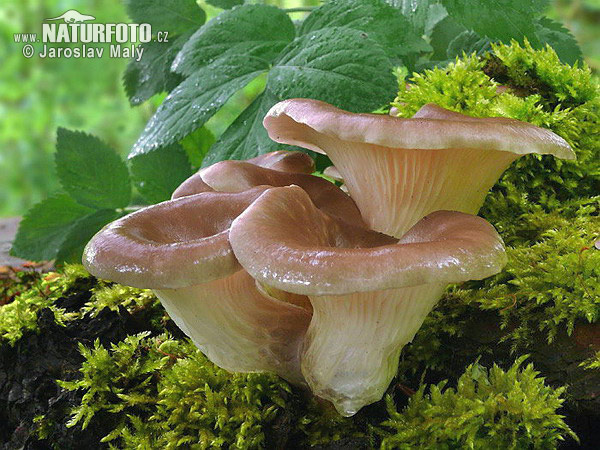
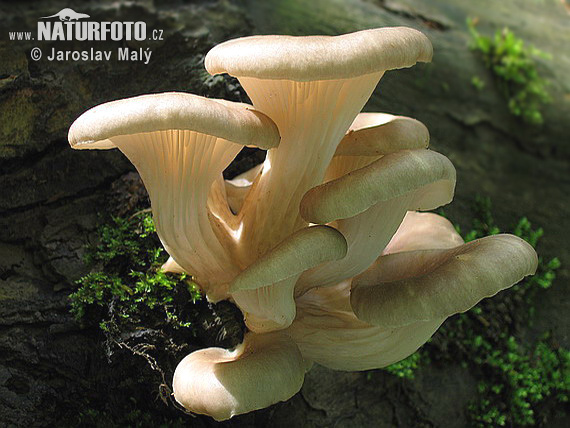
Pleurotus cornucopiae, the branching oyster mushroom , is an edible gilled fungus. Native to Europe.


The branching oyster mushroom, like other species of oyster mushroom, is a wood-decay fungus. In the wild,  most commonly decays hardwoods such as elm. Spores are spread by Callipogon relictus, a beetle.

Golden oyster mushrooms are cultivated commercially, usually on a medium of grain, straw, or sawdust. Pleurotus species are some of the most commonly cultivated mushrooms, particularly in China, due to their ease of cultivation and their ability to convert 100g of organic refuse into 50-70g of fresh mushrooms, which are up to 30% protein.


*******


Related Posts Plugin for WordPress, Blogger...